
My stepstool lives inside my staircase.
Not next to it — inside it. The apartment I rented in Providence had these boxy wooden stairs up to a lofted bedroom, and I noticed one of the risers had a seam that didn’t quite match the others.
Turned out the previous tenant had cut a little door into it. I fixed the hinge, and now that one step holds my stepstool, a toolbox, and a spare fan. Nobody who visits has ever noticed.
That’s the thing about hidden storage that actually works — it’s rarely the stuff you see in a “shocking small space transformation” video. It’s usually smaller, cheaper, and less dramatic than that, but it solves a real problem: small rooms don’t just need more storage, they need storage that doesn’t visually eat the room while it’s doing its job.
A giant shelving unit technically adds storage, but it also makes a 10×10 bedroom feel like a 10×10 bedroom with a shelving unit crammed into it. Hidden storage adds capacity without adding visual clutter, which in a small space is honestly the harder problem to solve.
I’ve pulled these from my own apartments, from a few reader emails after a smaller post I did on closets, and from a couple of genuinely clever builds I’ve seen friends do in rentals where drilling wasn’t even an option.
I’m grouping these by where the “hidden” space actually comes from — furniture, walls, floors, and doors — because once you start thinking in those categories, you start noticing dead space everywhere.
Hidden Storage Inside Furniture
This is the easiest category to start with because it usually requires zero construction — just buying (or repurposing) furniture that’s doing more than one job.
1. A storage ottoman that opens from the top.

I mentioned this in a past post and I’ll say it again here because it belongs on every hidden storage list: from across the room it just looks like an ottoman. Nobody clocks that it’s holding your extra blankets until you lift the lid.
2. A bed frame with drawers built into the base.

My friend Renata swapped to one of these in her one-bedroom in Austin and told me it replaced an entire dresser — she said the real win wasn’t the space itself, it was that the drawers are low and wide, so folded sweaters don’t get lost the way they do in a tall dresser drawer.
3. A bench seat with a lift-up cushion.

Same concept as the ottoman, but shaped like furniture that fits at the end of a bed or along a wall. It reads as a seat, not a storage unit, which is exactly the point.
4. A hollow headboard.

Some headboards have a gap between the front panel and the wall that’s just sitting empty. A slim floating shelf mounted inside that gap (behind where your pillows sit) can hold books or a charger without adding a nightstand’s worth of footprint.
5. Nesting side tables.

Two or three tables that stack inside each other instead of standing separately give you the option of one small table most days and three when people come over — and the two you’re not using aren’t taking up floor space at all.
6. A vanity or desk with a lift-top mirror.

These exist specifically for makeup storage, and they’re one of the few pieces of furniture that hides an entire category of clutter — brushes, palettes, hair tools — completely out of sight the second you close the lid.
Pro tip: Before buying any storage furniture online, check the actual interior dimensions in the listing, not just the exterior. I’ve been burned twice by an ottoman that looked roomy in photos but had a liner and padding that ate two extra inches off every side.
Hidden Storage Built Into Walls
This category ranges from “no tools required” to “ask your landlord first,” so I’ve flagged which is which.
7. Recessed shelving between wall studs.

If you have drywall and a landlord who’s open to minor changes (always get this in writing, even a text), you can cut a shallow shelf niche between two studs — usually about 14.5 inches — without losing any floor space at all, since the shelf sits flush with the wall. This is a real construction project, not a weekend hack, so it’s the one item on this list I’d only do in a place I planned to stay in for a while.
8. A mirror that opens like a cabinet.

Medicine-cabinet style mirrors aren’t just for bathrooms. A mounted mirror with a hidden hinge and a shallow interior can go in a bedroom or entryway and hold small items — jewelry, glasses, keys — while doing the job of a regular wall mirror the rest of the time.
9. Pegboard painted to match the wall.

A pegboard usually reads as “storage system” the second you see it, but painted the exact color of your wall, it nearly disappears until you actually hang something on it. My friend did this in a rental kitchen where cabinet space was almost nonexistent, and from a few feet away it just looks like a slightly textured wall.
10. A false gallery wall frame with a hidden compartment.

You can buy (or build) a deep shadow-box style frame that looks like part of a gallery wall arrangement but opens on a hinge to hold small flat items — documents, chargers, spare keys. It works because nobody expects a frame to be anything other than a frame.
11. Behind-the-door hooks and slim racks.

Not hidden in the dramatic sense, but functionally invisible once the door is open, which is most of the time. This is free real estate that almost nobody uses to its full potential — most people put one hook on the back of a door when there’s room for four or five.
Hidden Storage Under the Floor (or At Least, Under Something)
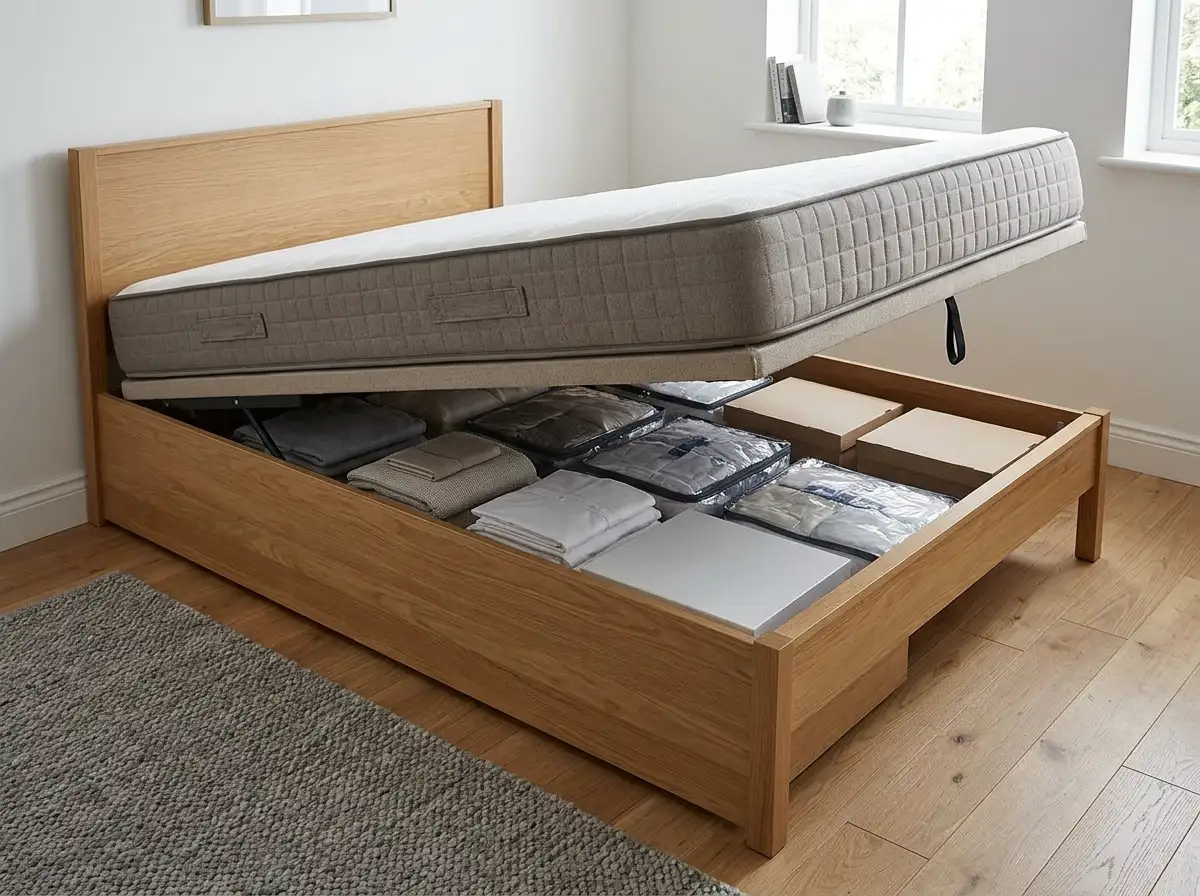
12. A platform bed with a lift-up frame.

Different from the drawer-style bed frame — this is a solid platform on hinges that lifts the entire mattress up, revealing one large open cavity underneath instead of a few drawers. It holds significantly more, though it does mean moving the mattress every time you need something, so it’s better for seasonal storage than daily-use items.
13. Bed risers with a bin system underneath.

If a full lift-up frame isn’t in the budget or you’re renting furniture-included, risers that lift your existing frame 4–6 extra inches create enough clearance for uniform bins to slide in and out easily, which is the part people usually get wrong — mismatched bin heights waste half the extra clearance you just paid for.
14. A storage cube ottoman doubling as a coffee table.

I know I already covered ottomans above, but this specific version — flat-topped, sturdy enough to hold a coffee tray — deserves its own mention because it replaces a coffee table entirely instead of sitting next to one, which is a bigger space win.
15. A rug with a hidden floor safe or hatch beneath it (only in owned spaces).
I’ll be upfront that this one’s a stretch for most renters, but if you own your place, a small in-floor safe under a rug corner is a genuinely hidden storage spot for documents or valuables that no visitor would ever think to check.
Hidden Storage in and Around Doors
16. A hollow-core door shelf insert.

Some hollow interior doors can be fitted with a slim shelf insert that slides into the cavity — this is a more involved project and really only makes sense if you’re already replacing a door, but it’s one of the more genuinely surprising uses of “dead” space in an apartment.
17. A sliding barn door with shelving built into the back.

If you’re already installing a barn-style door (common in a lot of newer small apartments to save the floor space a swinging door needs), the back face — the side that faces the wall when open — is usually empty. Mounting a slim shelf there uses space that would otherwise do nothing.
18. Over-the-door pocket organizers, but for rooms other than closets.

Most people only think of these for shoes. An over-the-door organizer in the kitchen holds spice packets and snack bags; in the bathroom it holds hair tools; in a home office it holds mail and cords.
19. A door-mounted ironing board.

These fold flat against the inside of a closet door and unfold when needed, which sounds minor until you realize a standalone ironing board is one of the most awkwardly-shaped things to store in a small space.
| Hidden Storage Type | Best Room | Renter-Friendly? | Effort Level |
|---|---|---|---|
| Storage ottoman | Living room, bedroom | Yes | Low (just buy it) |
| Bed frame with drawers | Bedroom | Yes | Low–medium (assembly) |
| Recessed wall shelving | Any | Only with landlord approval | High |
| Painted pegboard | Kitchen, craft space | Yes, with adhesive-mount versions | Medium |
| Bed risers + bins | Bedroom | Yes | Low |
| Door shelf insert | Bedroom, bathroom | No (structural) | High |
Hidden Storage in Overlooked Spots You Already Have
This last group isn’t a single furniture category — it’s the “dead zones” almost every small room has, whether or not you’ve noticed them yet.
20. The space above kitchen cabinets.

If your cabinets don’t reach the ceiling, that gap is usually just collecting dust. Matching bins or baskets up there hold items you use once a season — holiday dishes, a punch bowl — completely out of the way of daily life.
21. Inside a hollow ottoman leg or bench leg (rare, but it happens).

Some furniture pieces have surprisingly deep hollow legs meant for cord management that work just as well for small rolled items. Worth checking before you assume a piece is solid.
22. The gap behind a hung mirror or piece of art.

A slightly-too-small frame leaves a shadow gap behind it deep enough for flat items like a spare key or a thin folder, taped or clipped to the back where it’s invisible from the front.
23. Inside a stair riser, like mine.

Not every apartment has stairs, but if yours does and they’re the boxed-in wooden kind rather than open, check whether a riser can be converted — it’s more common in older buildings than you’d think.
24. The dead space beside a fridge.

Most fridges don’t sit flush against the cabinetry, leaving a 3–6 inch gap that a slim rolling cart is built specifically to fill. It’s one of the most-recommended small-kitchen fixes for a reason — that gap exists in almost every apartment kitchen and almost nobody uses it.
25. Behind a couch, using a slim console instead of nothing.

The strip of space behind a couch that’s pushed a few inches from the wall is usually wasted. A narrow console table there adds storage without changing how the room reads, since it’s tucked behind the largest piece of furniture in the room.
26. Underneath stairs, even without a hidden door.

If cutting into a riser is more than you want to take on, the triangular space under an open staircase can hold slim baskets or a small bookshelf built to the exact slope, and it’s one of those spots that looks intentional rather than crammed.
27. Inside a window seat.

If your apartment has a window seat, check whether the base lifts — a lot of them are built as storage benches, and I’ve talked to more than one renter who lived in their place for a year before realizing the seat cushion came off.
28. The inside of a coat closet door.

Beyond hooks, a shallow wire or fabric organizer mounted on the inside of a closet door (not the room’s main door) holds gloves, hats, and umbrellas in a spot most people leave completely bare.
29. A false-bottom drawer.

You can build (or buy furniture with) a drawer that has a removable panel a couple of inches above the true bottom, creating a shallow hidden layer underneath for things you want out of daily rotation — important documents, cash, jewelry.
30. Vertical space beside a bookshelf.

Bookshelves rarely reach the exact width of a wall, and that last 4–6 inch strip beside one is often ignored. A slim rolling file cart or magazine rack fits there and uses width that’s otherwise just gap.
31. Behind a hanging shower curtain, using a second rod.

A second tension rod mounted a few inches behind your main shower rod can hold a hanging mesh organizer for extra toiletries or cleaning supplies, completely hidden by the curtain itself during regular use.
Pro tip: Before you commit to any “cut into the wall or furniture” idea — the pegboard, the riser, the door insert — do a trial run with painter’s tape and cardboard first. It sounds excessive, but it’s saved me from at least two mistakes I would’ve had to patch or explain to a landlord.
What I’d Actually Do First
If I moved into a new small room tomorrow, I wouldn’t start with the wall projects, even though they get the most attention online. I’d start with the ottoman and the bed frame swap, because furniture-based hidden storage travels with you and doesn’t require anyone’s permission.
Once those two things were handled, I’d walk the room slowly and just look for gaps — beside the fridge, behind the couch, above the cabinets — because in my experience, most small rooms already have two or three of these spots sitting empty. You don’t usually need to build hidden storage from scratch. You mostly just need to notice the storage that’s already there, doing nothing.

Leave a Reply