
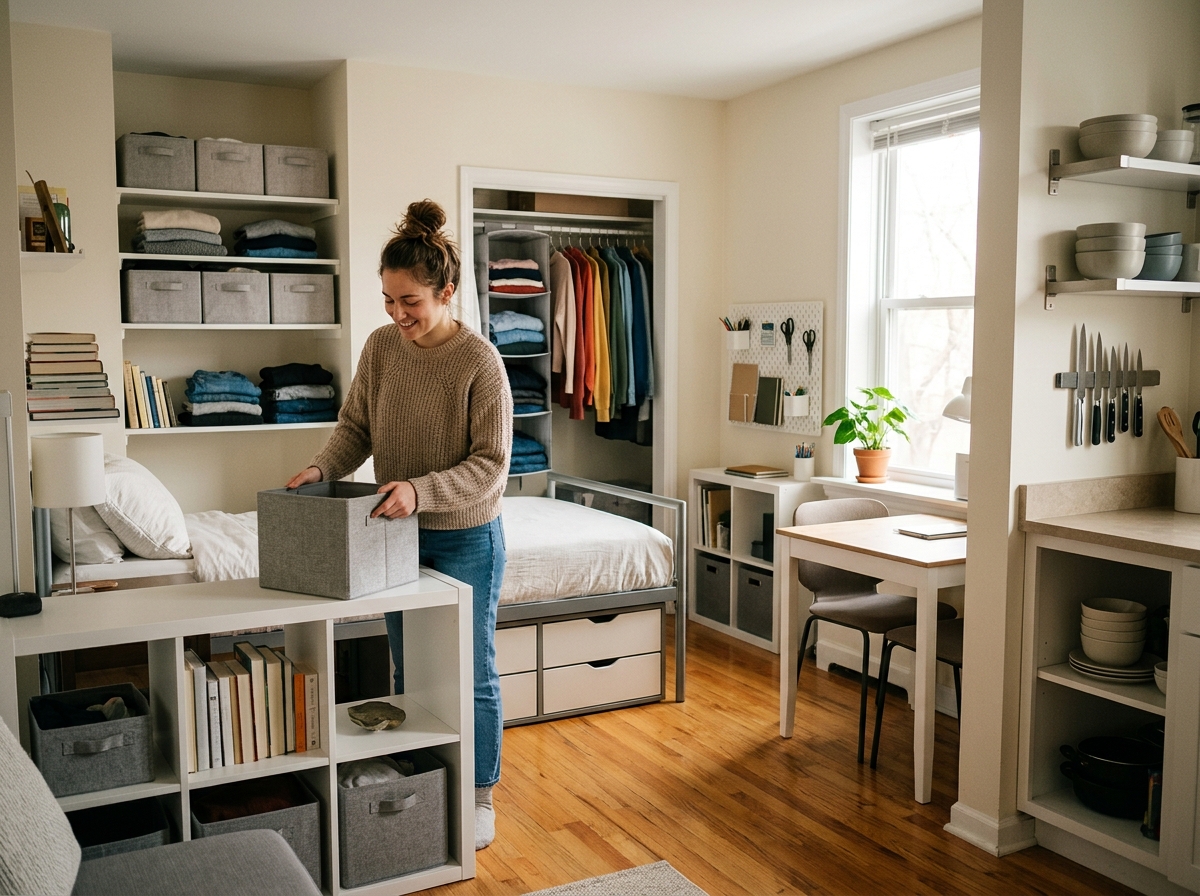
I moved into my first solo apartment three years ago — 480 square feet, one closet, and a kitchen with exactly four cabinets — and for the first two months, I did the thing everyone does: I bought a bunch of bins from Target on a Saturday, dumped stuff into them, and called it “organized.” It wasn’t.
By week three I couldn’t find my passport, my winter coat was on the floor of the closet under a pile of “maybe donate” clothes, and I had three half-used rolls of drawer liner I never actually used.
Small apartment organization isn’t a shopping trip. It’s a sequence. And if you start in the wrong place — buying containers before you know what needs containing — you end up exactly where I did.
If you’re standing in your apartment right now feeling like there’s “no room for anything” even though you don’t own that much stuff, I promise you it’s usually not a storage problem.
It’s a starting-point problem. This is the order I actually use now, and the one I walk friends through when they’re moving into their first small space — whether that’s a studio, a one-bedroom, or a dorm room that somehow needs to function as a bedroom, office, and closet all at once.
Start With a Purge, Not a Pinterest Board
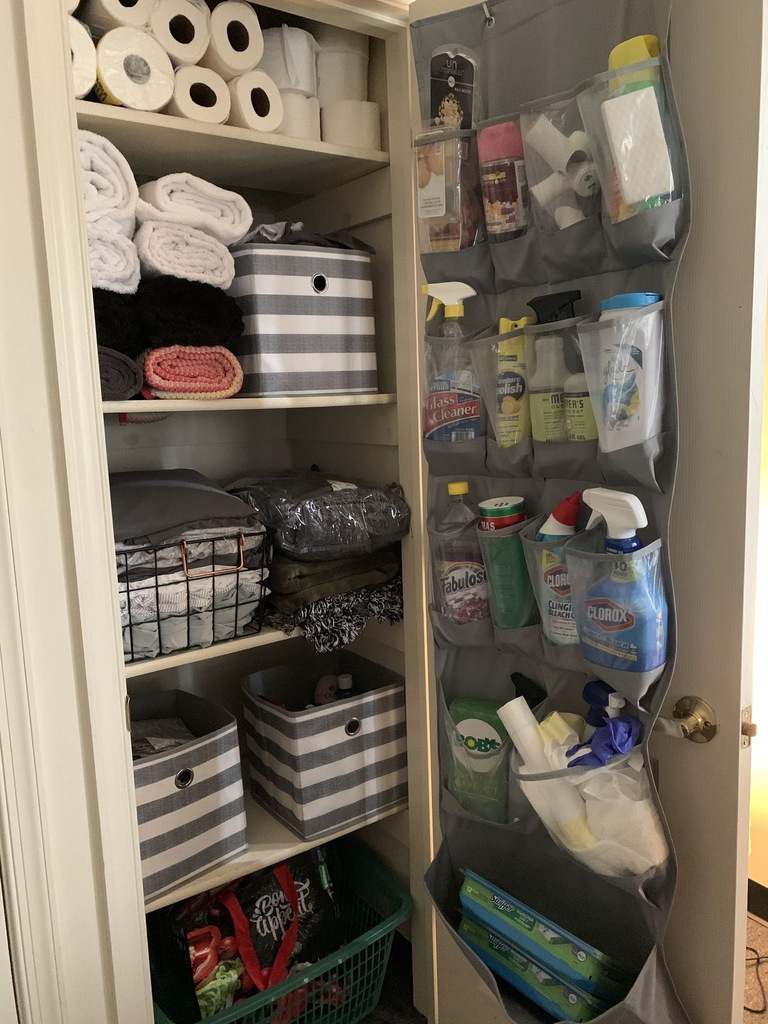
I know it’s tempting to skip straight to the fun part — the labeled bins, the matching hangers, the closet system that looks like a boutique. But here’s the thing: organizing clutter just gives you neatly arranged clutter.
My friend Priya did her entire studio’s “organization glow-up” in one weekend, bought about $300 in matching bins, and six months later admitted she’d never actually gone through and gotten rid of anything first. The bins were just prettier boxes for stuff she didn’t need.
Before you organize a single drawer, do a real purge. Not a “maybe I’ll use this someday” purge — an honest one. A decent rule that’s stuck with me: if you haven’t touched it in a year and it’s not seasonal (holiday decorations, winter coats, that kind of thing), it can probably go.
For clothes specifically, try the hanger trick — turn every hanger backwards at the start of the season, and flip it around once you actually wear the item. After three months, anything still backwards gets donated.
Pro tip: Do the purge in categories, not rooms — all your clothes at once, then all your kitchen stuff, then all your paperwork. Doing it room by room means you’ll purge the same category of stuff (like paper clutter) three or four different times in three or four different spots, and you’ll never get an honest read on how much you actually own.
Measure Before You Buy Anything
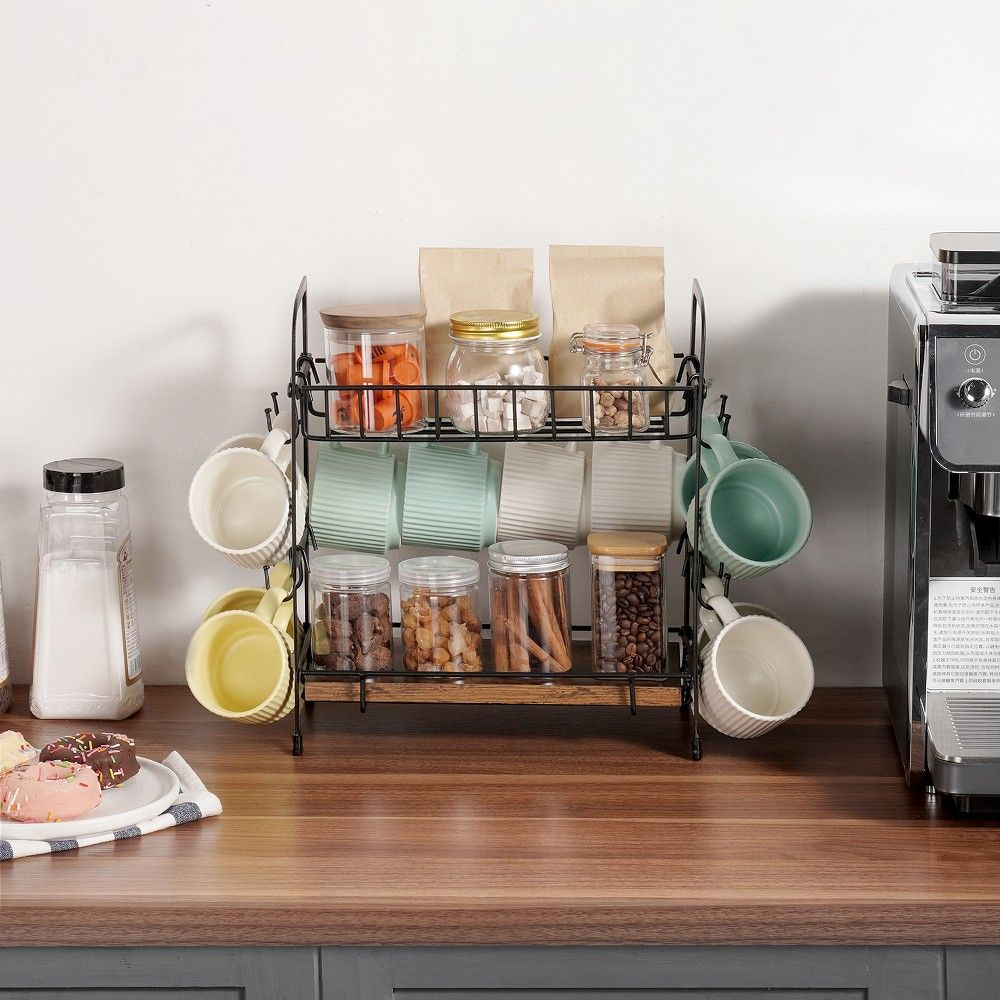
This is the step almost everyone skips, and it’s the one that turns “organizing” into “returning things to Target three times.” Before you buy a single bin, shelf, or organizer, actually measure your spaces — closet depth, under-bed clearance, the gap between your fridge and the wall, cabinet height.
I keep the measurements in my Notes app now because I have, more than once, bought a shoe rack that was two inches too tall for my closet shelf and had to eat the return shipping.
Small apartments punish guessing. In a bigger place, if a bin doesn’t fit one spot, you find it another home. In 450 square feet, there often isn’t another home — it just becomes a new pile.
Work Vertical Before You Work Wide
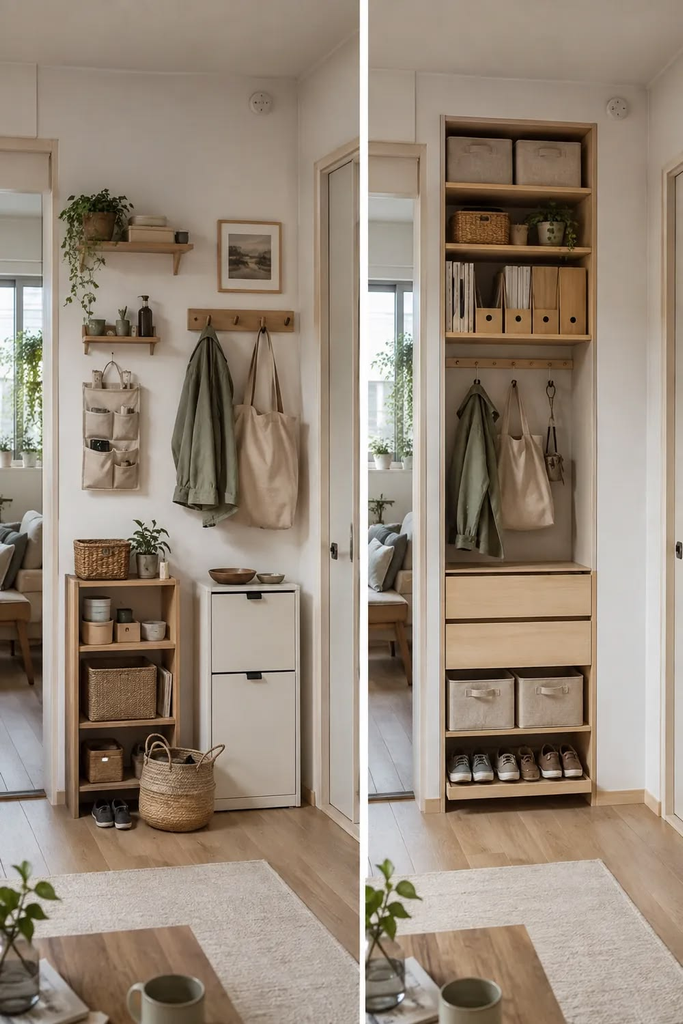
This is the single biggest mindset shift for small-space organization: you’re not short on space, you’re short on floor space.
Most small apartments have a lot of unused vertical real estate — wall space above furniture, the top third of closets, the gap above kitchen cabinets.
Floating shelves, over-the-door organizers, and tall narrow bookcases all use space you’re currently paying rent on and getting zero value from.
When I finally got real about this, I put up three floating shelves above my desk for books and added an over-the-door shoe organizer inside my coat closet — not for shoes, but for cleaning supplies, which used to live in a cabinet I actually needed for food. That one swap freed up more usable kitchen space than any bin I ever bought.
Pro tip: Check your lease before drilling anything. A lot of rental-friendly options now use Command strips rated for real weight (some hold up to 15–16 pounds per set), which means you can hang floating shelves and organizers without losing your deposit over drywall holes. I learned this the expensive way after patching six holes with toothpaste-and-paint, which — for the record — does not actually work as well as the internet promised.
Give Every Item One Home, and Put It Near Where You Use It
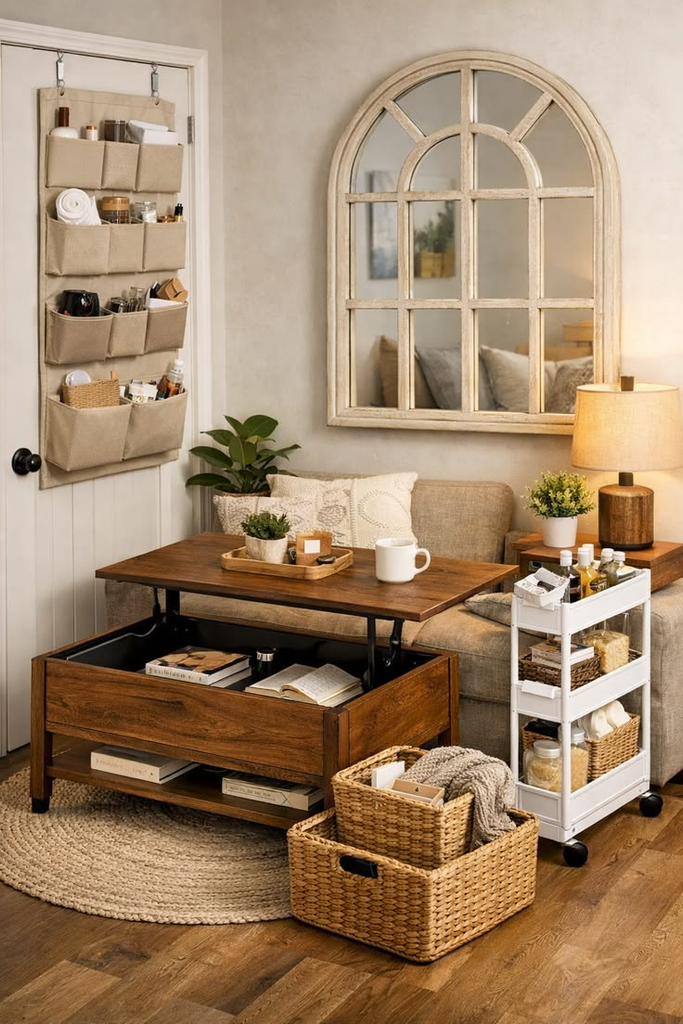
Here’s a mistake I made for a full year: I stored my out-the-door items — keys, sunglasses, mail — in my bedroom, because that’s where my dresser was.
Every single morning I was walking back and forth between my front door and my bedroom trying to leave the house.
It sounds small, but it added actual friction to my mornings, and it’s the kind of thing that quietly makes an apartment feel chaotic even when it’s not messy.
The fix is almost embarrassingly simple: store things where you use them, not where there happens to be an empty drawer.
Keys and mail go by the door. Extra towels go in the bathroom, not a hallway closet three rooms away. Chargers live near the outlet you actually use, not in a “cords” drawer in the kitchen.
A Quick Cost Comparison: Where to Actually Spend Money First
Not every organizing tool is worth the same investment, especially on a first-apartment budget. Here’s roughly how I’d rank spending priority if you’re starting from zero:
| Category | Approx. Cost Range | Worth It First? | Why |
|---|---|---|---|
| Closet organizer (hanging shelves or a basic rod system) | $15–$60 | Yes | Closets are usually the most wasted vertical space in a small apartment |
| Over-the-door organizers | $10–$25 | Yes | Cheap, no tools, adds storage without using floor space |
| Command-strip floating shelves | $20–$40 for a set | Yes | Rental-safe, high impact for books/decor/kitchen overflow |
| Matching decorative bins | $8–$20 each | Wait | Buy these after your purge, once you know exactly what needs containing and in what size |
| Under-bed storage containers | $15–$30 | Depends | Only worth it if your bed frame actually has clearance — measure first |
| Furniture with built-in storage (ottomans, storage beds) | $80–$300+ | Later | Great long-term investment, but a big spend to make before you know your actual storage gaps |
I’d skip the matching-bin aisle entirely on your first shopping trip. It’s the most fun part of organizing and the easiest place to overspend on containers for stuff you’re about to realize you don’t need.
For Dorms and Studios Specifically: A Few Extra Notes
If you’re working with a dorm room instead of an apartment, a couple of things change. You usually can’t drill or use heavy-duty adhesive strips at all, so tension rods (the kind that wedge into a closet or under a lofted bed) do a lot of the work that floating shelves would otherwise do.
Bed risers are also worth the roughly $15–$20 they cost — they turn under-bed space from “storage nobody uses” into genuinely usable bin space, especially in dorms where the bed can’t be adjusted any other way.
Studio apartments have their own specific challenge: no doors between “zones.”
I use a tall bookshelf as a soft room divider between my sleeping area and living area — it does double duty as storage and as a visual line that makes the studio feel like it has two rooms instead of one big undefined box.
What I’d Do Differently If I Started Over
If I were moving into my first small apartment again, I’d skip the bin-buying trip entirely for the first two weeks. I’d purge first, actually live in the space for a bit to notice where the real friction points are — where I keep dropping stuff, where I keep having to walk too far for something I use daily — and only then measure and buy.
It’s less satisfying than an instant weekend glow-up, but it’s the difference between an apartment that looks organized in photos and one that actually stays that way six months later.
Small apartment organization isn’t really about fitting more stuff into less space. It’s about making sure the stuff you actually keep has an obvious, close, sensible home — so putting things away is easier than leaving them out.

Leave a Reply