
I unpacked my kitchen boxes into eleven cabinets that, combined, gave me less storage than the pantry closet in my childhood house.
That’s not an exaggeration — I measured it once out of spite. Two of the cabinets were over the fridge and basically unreachable, one had a pipe running diagonally through it for no reason I could ever explain, and the lazy Susan corner cabinet ate space instead of saving it.
If you’ve ever stood in your kitchen holding a stand mixer with nowhere to put it, you already know this feeling.
This isn’t a “just buy a bunch of matching bins and it’ll look like a magazine” post. Most small kitchens don’t have a clutter problem, they have a layout problem — deep cabinets that swallow things, wasted vertical space above your sightline, and dead corners nobody designs for.
The fixes that actually work are the ones that account for how your specific cabinets are shaped, not generic advice that assumes you have a 2020s builder-grade kitchen with soft-close everything.
Below is everything I’ve actually used, tested, or watched a friend return after it didn’t work — organized by the type of dead space it fixes, plus a cost breakdown near the end because “just get organizers” can get expensive fast if you buy the wrong ones first.
Start With an Audit, Not a Shopping Cart
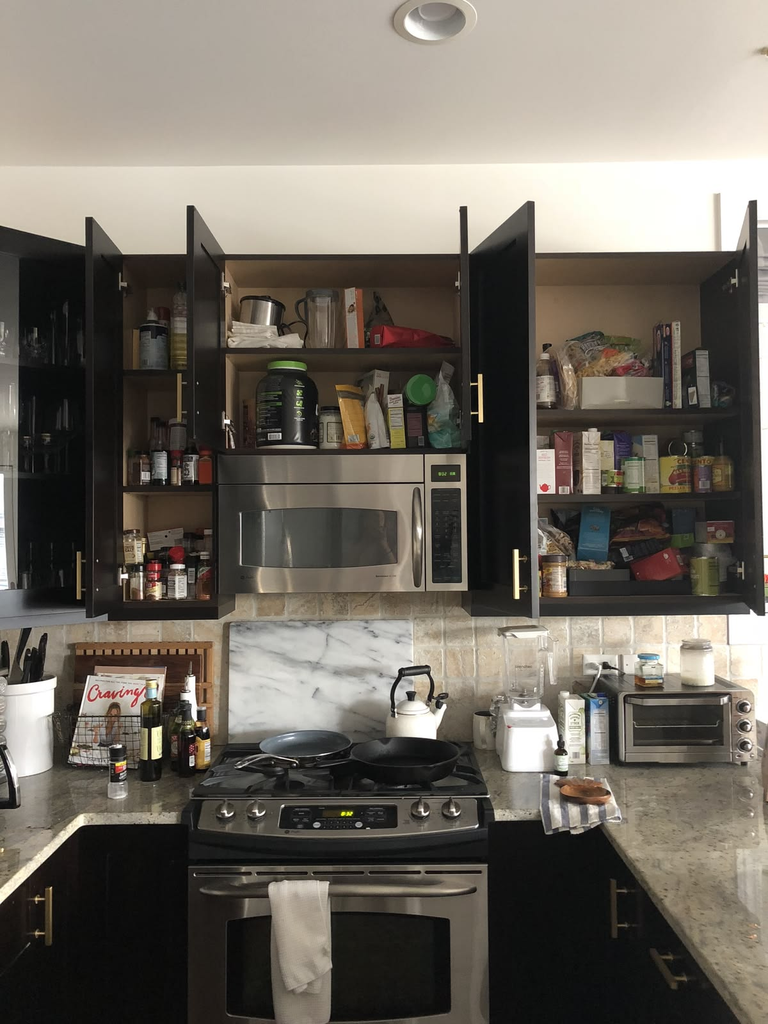
Before you buy a single bin, empty one cabinet at a time and sort into three piles: things you used in the last month, things you use seasonally, and things you’re keeping out of guilt.
That third pile is bigger than people expect — I found a fondue pot I’ve used exactly once in six years, and a set of ramekins I bought for a recipe I never made.
The reason this matters for space, not just tidiness: cabinet organizers only help if the cabinet has room to be organized. If you’re storing daily-use dishes behind seasonal ones, no amount of stacking product fixes that — you need to physically relocate the seasonal stuff first, even if that means a bin in the coat closet.
Pro tip: Sort by frequency of use, not by category. A “baking” cabinet sounds tidy, but if you bake twice a year and use your everyday pans daily, grouping them by theme instead of use means you’re still digging past cake pans for a saucepan every night.
Fix the Deep Base Cabinets First
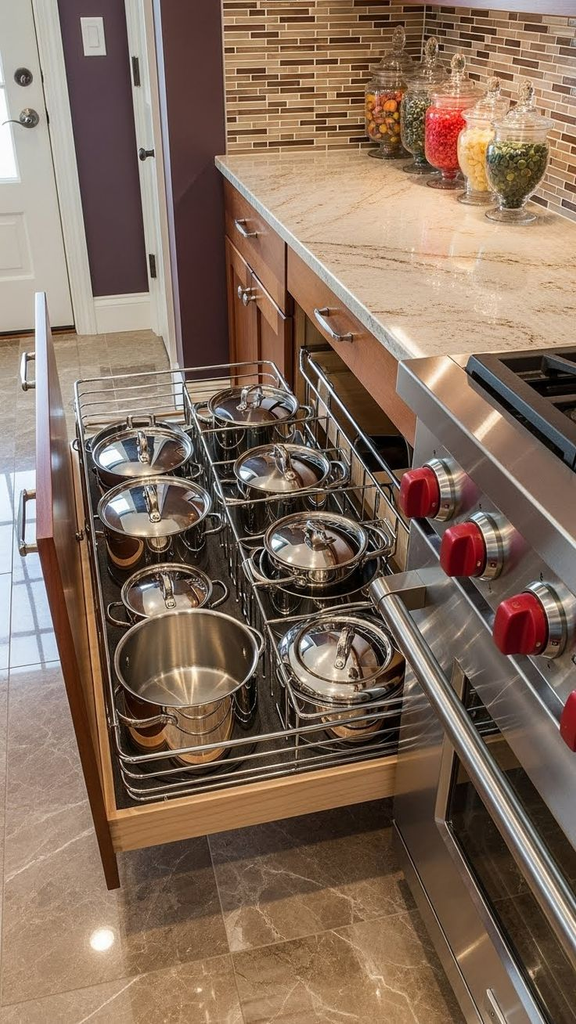
Base cabinets — the ones under your counter — are almost always the worst offenders because they’re deep enough to lose things in the back. I had a base cabinet where I genuinely forgot I owned a second colander for over a year.
Pull-out drawer organizers are the single highest-impact upgrade here, and they don’t require any tools beyond a screwdriver in most cases.
The kind that mount to existing shelves and slide out like a drawer let you see and reach the back of the cabinet without kneeling on the floor and reaching blind, which is how I chipped a bowl trying to grab a pot lid last winter.
If a full pull-out system is out of budget, a lazy Susan turntable for pots, oils, or cleaning supplies does almost the same job for a fraction of the price — you’re just spinning instead of sliding.
Pro tip: Measure the interior depth of the cabinet, not just the width, before ordering anything. I ordered a pull-out shelf that was rated for my cabinet’s width but didn’t account for a support bracket two inches in, and it wouldn’t sit flush. Return shipping on a metal shelf is not a fun errand.
Use Vertical Dividers for Pans and Trays
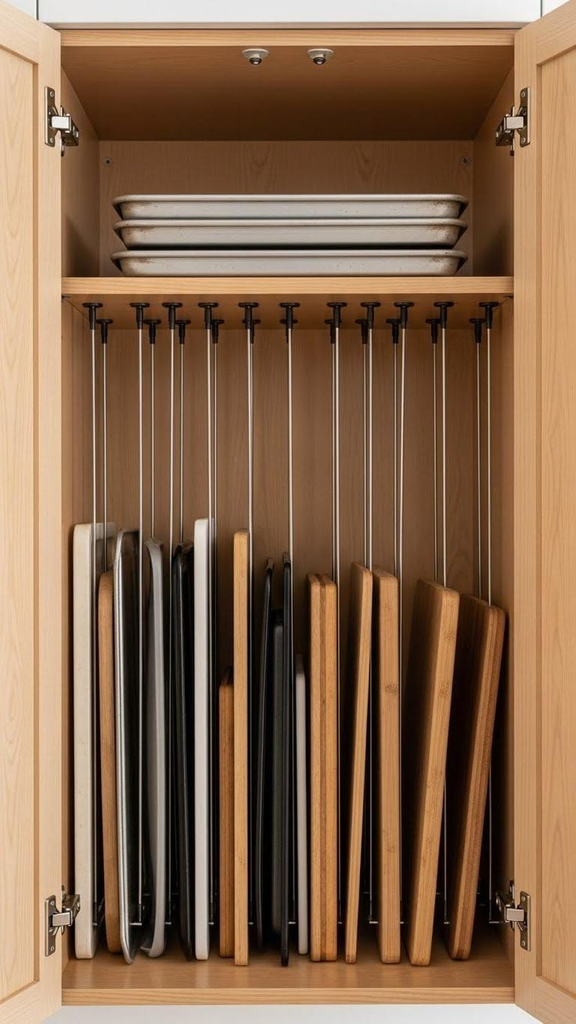
Flat stacking is the default because it’s what the cabinet came with, but it’s genuinely one of the worst uses of vertical space for anything flat and awkward — sheet pans, cutting boards, muffin tins, cooling racks.
If the pan you need is on the bottom of the stack, you’re unloading the whole thing to get to it.
Vertical dividers (either a standalone rack or tension rods mounted inside a cabinet) turn that same footprint into individual slots, so each pan slides out on its own.
This is one of the few upgrades where the “before” and “after” is dramatic enough that I’ve had guests ask about it specifically, which almost never happens with kitchen organization.
Pro tip: Tension rod dividers are the cheapest version of this — a few dollars each from a hardware store — and they work almost as well as the purpose-built racks for cabinets that are already tall enough. I only upgraded to the metal rack version because my cabinet was too shallow for the rods to sit straight.
Reclaim the Corner Cabinet
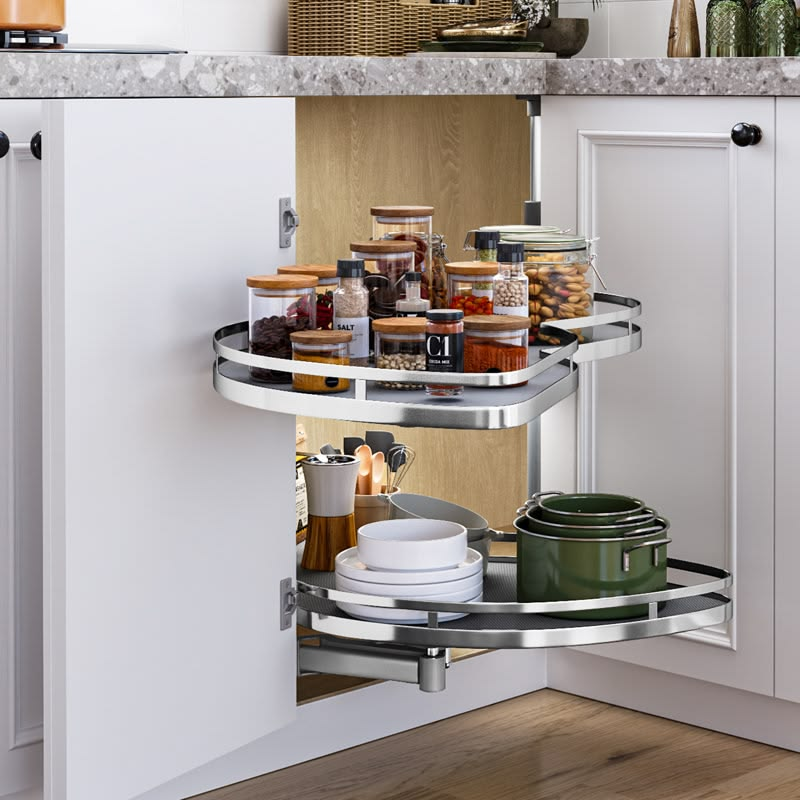
Corner cabinets are the most-wasted space in almost every small kitchen, and the “solution” that comes standard — a basic lazy Susan — is honestly kind of mediocre.
Round shelves in a space that’s mostly square-ish leaves gaps in the corners that nothing fits into, and anything you put in the back third of the turntable still gets lost when it spins out of reach.
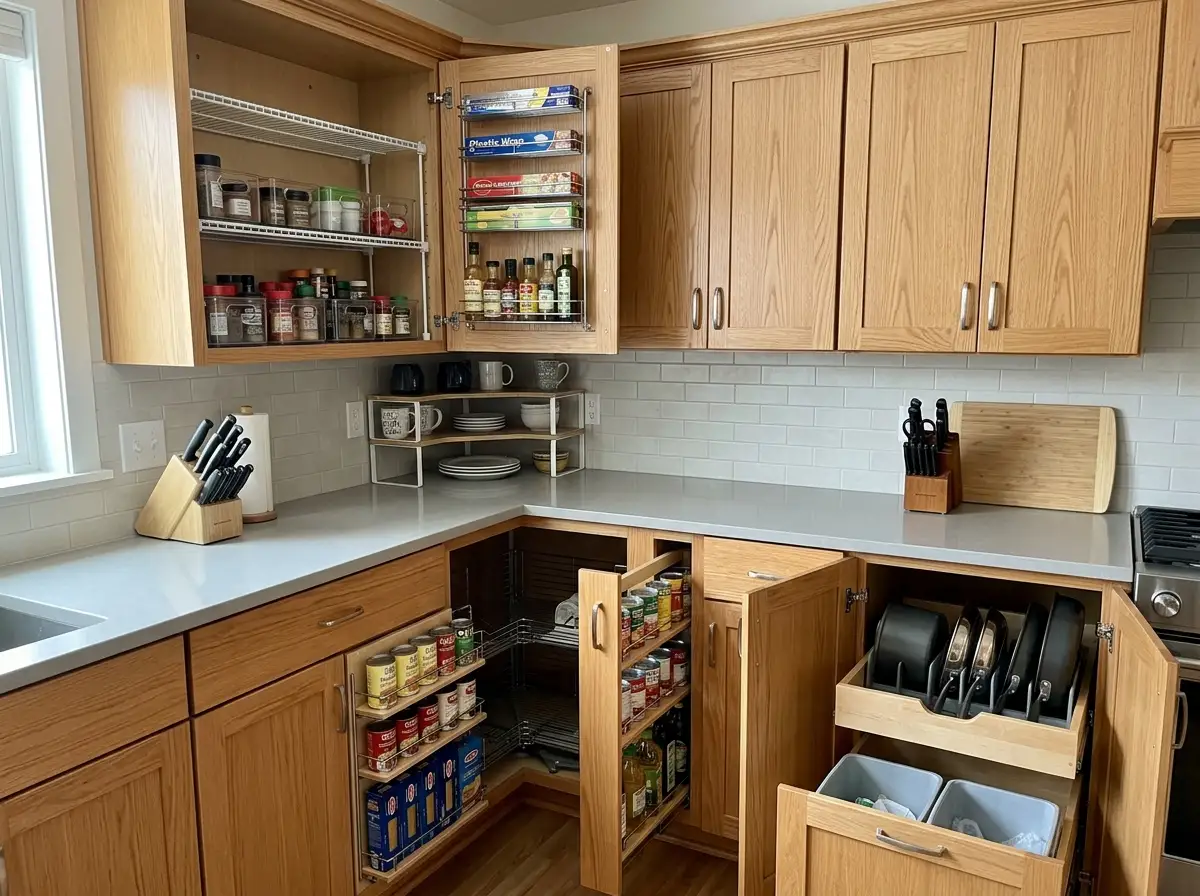
A kidney-shaped or two-tier “super Susan” style organizer, or pull-out corner shelving that swings out like a door, uses that dead space far better.
It costs more, but if your corner cabinet is currently storing three things and a lot of empty air, it’s the upgrade that pays for itself fastest per square foot.
My upstairs neighbor swapped her round lazy Susan for a pull-out corner unit last year and told me it was the first time in the apartment she’d used the back of that cabinet for anything besides a single forgotten jar of something.
Go Vertical Above the Sightline
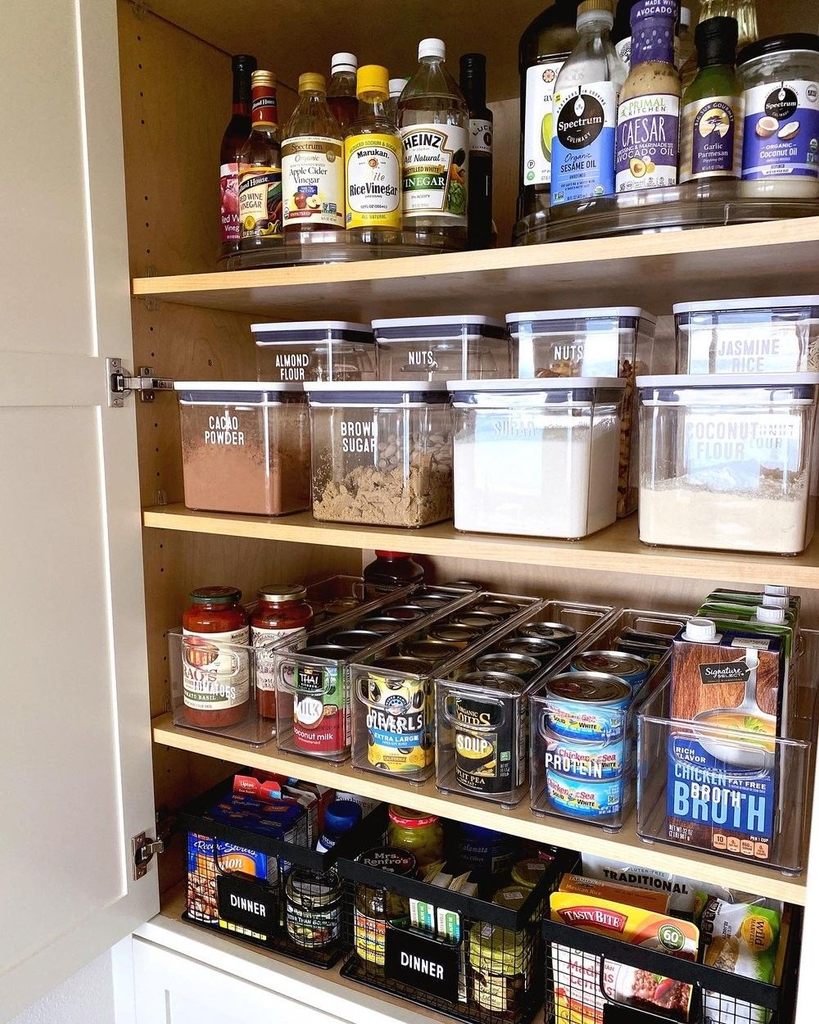
Anything above eye level in a small kitchen basically becomes storage for things you use once a season, and that’s fine — the problem is most people don’t organize it, they just stack loosely and hope.
A few stackable, clear bins for that top shelf (labeled, if you’re the type who’ll actually keep it up) means you’re not pulling down three things to find the one you need.
If you have any open wall space near the cabinets — even a strip 12 inches wide — a hanging rail with hooks can hold mugs, ladles, or measuring cups that would otherwise compete for drawer space.
This is one of the more talked-about small-kitchen ideas on Pinterest right now, and it’s popular for a real reason: it’s genuinely one of the few upgrades that adds storage without touching a single existing cabinet.
Pro tip: Don’t put daily-use items on the top shelf just because there’s room. I made this mistake with my mixing bowls and ended up on a step stool multiple times a week, which defeats the entire point of organizing.
Use the Inside of the Cabinet Doors
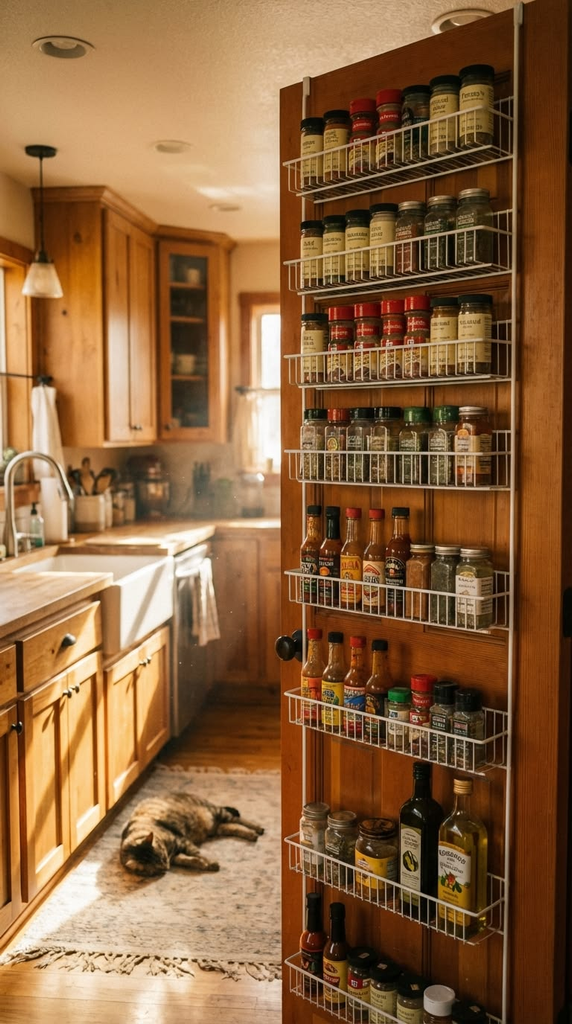
This is the most underrated square footage in a small kitchen, full stop. The flat interior of a cabinet door can hold a spice rack, cutting boards, lids, foil and wrap boxes, or a small trash bag holder — all without using an inch of shelf space.
The catch is weight and depth. A door-mounted rack loaded with heavy glass spice jars can strain hinges over time, and anything too deep will hit the shelf behind it when you close the door.
I learned the depth issue the hard way with an over-the-door spice rack that wouldn’t let the cabinet close all the way, so it sat propped open for two weeks before I swapped it for a shallower version.
Pro tip: Measure the gap between the door and the first shelf before buying anything door-mounted — most are under 3 inches, and a lot of “space-saving” racks are deeper than that.
Compare: Which Organizer Actually Fits Your Cabinet
Not every organizer works for every cabinet shape, so here’s the breakdown I wish someone had given me before I bought three things that didn’t fit.
| Organizer Type | Best For | Typical Cost | Watch Out For |
|---|---|---|---|
| Pull-out drawer shelves | Deep base cabinets, pots/pans | $30–$80 per shelf | Interior depth and support brackets — measure twice |
| Tension rod dividers | Sheet pans, trays, cutting boards | $5–$15 total | Needs a tall-enough cabinet to sit vertically |
| Standalone vertical rack | Same as above, sturdier | $20–$45 | Takes up more shelf footprint than tension rods |
| Corner “super Susan” or pull-out | Wasted corner cabinets | $60–$150 | Needs precise measuring; not all corner cabinets are the same shape |
| Stackable clear bins | High shelves, seasonal items | $10–$25 for a set | Only worth it if you’ll actually label and maintain them |
| Door-mounted racks | Spices, lids, wraps | $10–$30 | Depth clearance — check before buying |
| Under-shelf baskets/risers | Doubling shelf space for mugs, cans | $10–$20 for a set | Weight limits on thin wire shelves |
What I’d Actually Buy First, on a Real Budget
If you can only do one thing this month, do the base cabinet pull-out or the tension rod dividers — they’re the cheapest, most reversible (renters, this means you), and they solve the two biggest daily annoyances: not seeing what’s in the back of a deep cabinet, and not being able to grab one pan without a small avalanche.
The corner cabinet and the door-mounted racks are worth doing next, in that order, because they reclaim space you’re currently paying rent or mortgage on and getting nothing back for.
If You Rent: What’s Actually Renter-Safe
Almost everything above is renter-friendly because none of it requires drilling into cabinet frames — tension rods, adhesive hooks rated for the weight you’re hanging, and shelves that clip onto existing cabinet lips rather than screw in.
The one exception is door-mounted racks that use screws instead of adhesive strips; check the packaging before you buy, since some brands only sell the screw-in version.
If your lease is strict about wall damage, skip the hanging rail idea and stick to inside-the-cabinet solutions — you get most of the benefit without the move-out inspection stress.
What I’d Do Differently If I Started Over
Honestly? I’d skip the impulse bin purchases entirely and start with the audit. I bought a set of stackable containers before I’d even figured out what needed containing, and half of them sat empty in a cabinet for months because I hadn’t actually sorted anything yet. The order matters more than the products — empty and sort first, measure your actual dead space second, and only then start buying.
It’s less satisfying than a shopping trip, but it’s the difference between a kitchen that stays organized and one that looks good for exactly two weeks.

Leave a Reply